
Objectives
- Understand that learning happens in multiple ways and that college, for the most part, requires learning beyond the level of knowledge and understanding
- Identify the learning levels in Bloom’s taxonomy
- Recognize the role of learning levels in studying
- Develop the ability to ascertain levels of learning required by course objectives
- Apply learning levels to sample questions
- Create sample test questions at various learning levels
Bloom’s Taxonomy describes types of learning. It is best represented as a pyramid where the foundation of learning is shown at the bottom, with increasingly more complex types of learning as you move upward.

In high school, you might have been responsible for acquiring basic knowledge of facts and figures, the foundational knowledge. However, college courses require more complex levels of learning, such as applying what you know to solve a problem or describe a situation, analyzing something to understand how it works, evaluating something, or creating something new.
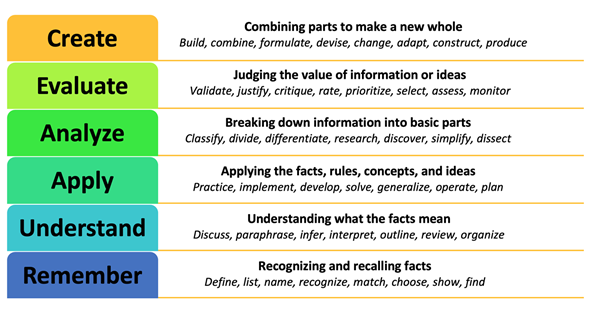
It is important to study at the level at which you will be expected to demonstrate competency, so you might need to figure out what your professor is requesting from you. You can do this by reading the syllabus closely and looking at the assignments, by doing a post-test analysis, or by talking to your professor or teaching assistant. An academic coach from the Academic Success Center can also help you understand how to approach studying for a specific class.
Instructor Resources
Electronic book. (2015). College Success. 104-107. Retrieved from https://open.umn.edu/opentextbooks/textbooks/college-success
Mcguire, S. Y. (2015). Teach Students How to Learn : Strategies You Can Incorporate Into Any Course to Improve Student Metacognition, Study Skills, and Motivation. Stylus Publishing. Retrieved from and available online at http://search.ebscohost.com/login.aspx?direct=true&db=nlebk&AN=1083022&site=ehost-live
This work is licensed under a Creative Commons Attribution-NonCommercial-NoDerivs 3.0 Unported License. You may reproduce it for non-commercial use if you use the entire handout and attribute The Academic Success Center, Texas A&M University.
Summary of Actions, via Slides and Activities
- Introduce Bloom’s taxonomy using the information above and provide an overview of the levels.
- Slides
- Explain the role of Bloom’s in influencing the creation of learning outcomes for classes.
- Explain the role of Bloom’s in influencing curriculum design and assessment.
- Explain to students that they should be able to identify the levels their instructor expects from the course learning objectives and that they should be able to design study materials and practice tests accordingly. Ask students to look at a syllabus and discuss levels of learning necessary in a class based on learning objectives.
- Review each learning level individually and the associated example assignments/questions.
- In groups or as a class, apply Bloom’s Taxonomy to Goldilocks and the Three Bears and discuss.
- In groups or individually, have students do the Recognizing Learning Levels from Questions worksheet.
- Discuss the worksheet.
- Discuss how awareness of the connection between Bloom’s and learning outcomes can inform the way you make and use study materials.
- Demonstrate how Blooms influences textbook construction.
- (Optional) Ask students to complete the Creating Test Questions at All Levels worksheet.
- Review final tips/key takeaways